
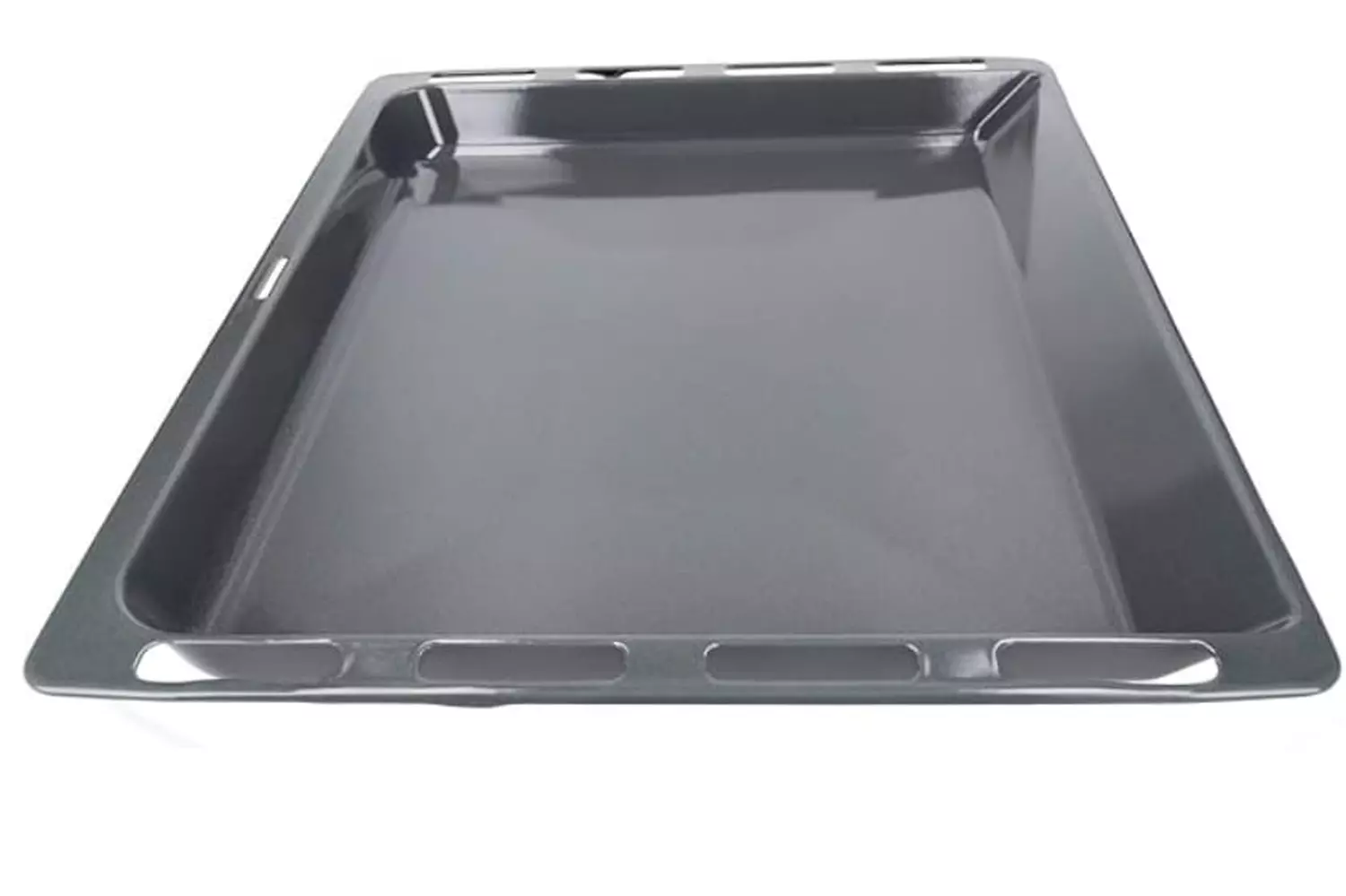
Most home cooks never notice this small detail, yet the slanted edge of oven trays serves a crucial purpose that can dramatically improve your cooking results. This seemingly insignificant design feature has confused countless people who assume they know how to use their baking sheets correctly. Understanding the proper orientation of your oven tray can make the difference between perfectly cooked meals and disappointing results with burnt edges and raw centers.
Understanding the design behind your baking tray
When you examine your oven tray closely, you’ll discover that one side features a sloped edge while the other sides form perfect right angles with the base. This asymmetrical design isn’t a manufacturing flaw or a cost-cutting measure. Kitchen equipment manufacturers deliberately engineered this feature to enhance the performance of modern ovens, particularly those equipped with convection capabilities.
The angled side creates a strategic gap between the tray and the oven wall when positioned correctly. This space allows hot air to circulate more efficiently throughout the cooking chamber, ensuring that heat reaches every corner of your food evenly. Without this circulation, you’d face the common problem of dishes cooking unevenly, with some portions overdone while others remain undercooked.
Many people mistakenly believe the slanted side exists to make removing food easier after cooking. While that would be a practical feature, it’s not the actual purpose. The confusion leads most home cooks to insert the tray with the angled edge facing forward, toward the oven door, which completely defeats its intended function.
The correct way to position your oven tray
Here’s the counterintuitive truth : the slanted side should face the back of your oven, not the front. By inserting the angled edge first and pushing it toward the rear wall, you create optimal conditions for air circulation. This positioning particularly benefits convection cooking modes, where a fan distributes heated air throughout the oven cavity.
When the angled side sits against the back wall, hot air flows smoothly over and around your food, eliminating cold spots and ensuring consistent browning. This technique works especially well for :
- Roasted vegetables that need even caramelization
- Cookies and pastries requiring uniform baking
- Fish and poultry that must cook through without drying
- Crispy fries or roasted potatoes with golden exteriors
However, before you rush to reposition all your trays, there’s an important caveat to consider. Oven designs vary significantly between manufacturers, and some newer models operate differently than traditional ones. Advanced heating systems and improved fan technologies have changed the optimization strategies for certain brands.
Recent documentation from leading manufacturers like Bosch actually recommends the opposite orientation, explicitly instructing users to place the slanted edge toward the oven door. These contradictory guidelines reflect ongoing innovations in oven engineering and different approaches to heat distribution. Just like professional cleaners have specific methods for maintaining ovens, manufacturers develop unique systems for optimizing their cooking performance.
Why manufacturer instructions matter for optimal results
The discrepancy between traditional wisdom and modern guidance highlights the importance of consulting your specific oven manual. What works perfectly for one appliance might compromise performance in another. Energy-efficient convection modes introduced in recent years operate with different airflow patterns than older models, requiring adjusted techniques.
Your oven’s instruction booklet contains valuable information about tray positioning, rack placement, and cooking mode selection. Manufacturers conduct extensive testing to determine the best practices for their particular designs. Ignoring these recommendations means you’re not getting the full potential from your appliance, potentially wasting energy and compromising food quality.
Temperature calibration also plays a role in achieving perfect results. Ovens can develop hot spots or temperature inconsistencies over time, affecting how well your food cooks regardless of tray orientation. Regular maintenance helps preserve even heat distribution throughout the cooking chamber. Keeping your oven clean prevents grease buildup that can interfere with proper airflow, much like addressing commonly overlooked dirty areas in your home improves overall cleanliness.
Maximizing your baking sheet’s versatility
Beyond proper orientation, understanding the multiple functions of your oven tray expands your cooking capabilities. These versatile tools serve purposes beyond simple baking, functioning as roasting pans, catch trays for dripping juices, and even makeshift griddles for certain preparations.
The material composition of your tray affects cooking performance as well. Heavy-gauge aluminum distributes heat more evenly than thin sheets, while dark finishes absorb heat differently than shiny surfaces. Matching your tray type to your cooking task produces superior outcomes, whether you’re baking delicate pastries or roasting hearty root vegetables.
Proper cleaning extends the life of your baking sheets and maintains their performance characteristics. Burnt-on residue creates uneven surfaces that affect heat transfer and can impart unwanted flavors to food. Using appropriate cleaning products makes maintenance easier without damaging the tray’s finish. Similar to how effective cleaning solutions tackle stubborn buildup in other areas, the right approach keeps your bakeware in optimal condition.
Taking time to understand the engineering behind everyday kitchen tools transforms your cooking experience. That innocuous slanted edge represents thoughtful design meant to enhance your culinary success. Whether you position it forward or backward depends on your specific oven model, but knowing the principle behind the feature empowers you to make informed decisions and achieve consistently excellent results.
