
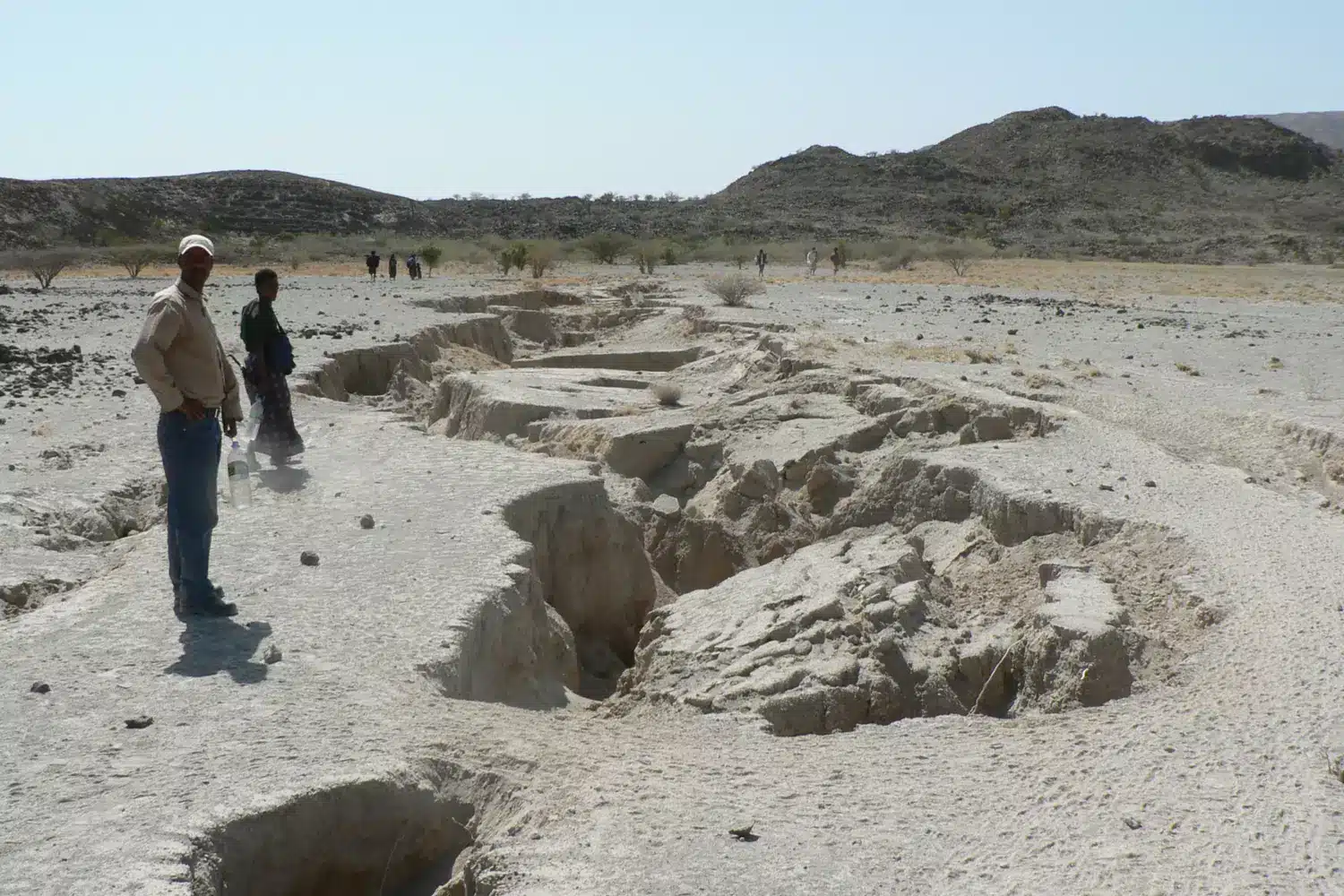
Sixty kilometers. That’s the length of the crack that ripped open in western Ethiopia in 2005 — in a matter of days. The ground split apart by two full meters, a shift geologists would normally expect to unfold over centuries. That single event redefined how scientists think about the pace of continental breakup. Africa isn’t just drifting slowly into geological history : a continent is splitting in two, the rift is already visible on satellite imagery and in the landscape itself, and the clock is ticking toward the formation of an entirely new ocean.
The East African Rift System : a fracture zone like no other
Stretching more than 6,000 kilometers from the Red Sea down to Mozambique, the East African Rift System ranks among the most dramatic active geological features on Earth. Three major tectonic plates converge here : the African plate, the Somali plate, and the Arabian plate. Their slow, relentless divergence has been pulling the continent apart for roughly 25 million years, carving out deep valleys flanked by volcanic ridges and towering peaks — including Kilimanjaro, Africa’s highest summit.
This isn’t abstract geology. Drive through Ethiopia, Kenya, or Tanzania and you’ll cross landscapes visibly shaped by crustal tension : escarpments dropping hundreds of meters, chains of crater lakes aligned along fault lines, and hot springs venting from the ground. The Horn of Africa — encompassing Somalia, Ethiopia, and Kenya — is pulling away from the rest of the continent at a rate of several millimeters to a few centimeters per year. Slow by human standards, but geologically relentless.
What drives this ? The process is called continental rifting, and it works through a combination of forces :
- Mantle convection currents pulling lithospheric plates in opposite directions
- Volcanic upwelling that thins and weakens the crust from below
- Gravitational spreading along elevated rift shoulders
- Accumulated stress released through seismic activity and surface fractures
The 2005 Ethiopian event illustrated just how non-linear this process can be. Rather than a slow, invisible creep, the Afar region experienced sudden, dramatic rupture — raising urgent questions about whether the full continental separation could arrive sooner than most models predicted. Some geologists remain cautious, insisting the complete split is still millions of years away. Others point to that 60-kilometer fissure as evidence that tectonic systems can leap forward unexpectedly. Either way, the direction is not in doubt.
How a rift becomes a sea : lessons from the Atlantic and the Red Sea
Gilles Chazot, geologist and professor at the University of Western Brittany, puts it plainly : “Oceans on Earth are born from the fracturing of a continent that splits in two.” The mechanism is well-documented. When a rift widens enough, seawater infiltrates the depression. The crust continues to thin. New oceanic crust forms through seafloor spreading. Over millions of years, what began as a crack in dry land becomes a full ocean basin.
The Atlantic Ocean formed exactly this way, when Africa and the Americas separated. The Red Sea offers a more recent — and still ongoing — example : it’s a young ocean in the making, barely 30 million years old, still narrower than most mature ocean basins. East Africa’s rift is following the same trajectory. The Afar region, at the junction of three tectonic plates in northern Ethiopia, already dips below sea level in places and fills periodically with salt flats — a geological preview of what’s to come.
The projected outcome ? The Horn of Africa eventually becomes a massive island, separated from the mainland by a new inland sea extending from the Afar Depression down through Kenya and possibly along Tanzania’s northern border. This would permanently redraw the continent’s geography and, critically, reshape access to one of the world’s most strategically vital corridors. The Horn of Africa guards the entrance to the Red Sea and the Suez Canal — a route through which a significant share of global oil and container traffic passes daily. Geologists are only beginning to model what a shifted coastline there might mean for regional trade patterns and marine ecosystems.
This kind of unexpected, large-scale transformation of familiar geography echoes other phenomena where reality outpaces conventional assumptions — much like tourists who blindly follow GPS directions and end up stranded somewhere no map anticipated. Systems we think we understand can produce outcomes that catch us completely off guard.
What this continental split means for the future — and what to watch now
For most people, millions of years feels safely abstract. But the science here has immediate, observable dimensions worth paying attention to. Seismic monitoring networks across Ethiopia, Kenya, and Tanzania are recording increased activity along rift fault segments. Volcanoes like Ol Doinyo Lengai in Tanzania and Erta Ale in Ethiopia remain persistently active, feeding heat and material into the widening fracture zone. Ground deformation measurements using GPS and InSAR satellite data capture millimeter-level changes in real time.
Researchers at institutions like the Geological Society of America and Ethiopia’s Institute of Geophysics, Space Science and Astronomy continue to refine models of rift propagation speed. The 2005 rupture forced a significant recalibration of those models. If similar acceleration events occur closer to the coast — near Djibouti or the Gulf of Aden — the timeline for marine incursion into the rift valley could compress dramatically.
There’s a useful analogy in entirely different domains : sometimes a process that seems impossibly slow reaches a tipping point and accelerates sharply. Iceland’s four-day workweek experiment showed how structural changes, once thought marginal, can validate bold predictions faster than skeptics expect. The same logic applies to plate tectonics : don’t assume tomorrow looks like today.
For those genuinely curious about monitoring this split, the EARS (East African Rift System) project publishes open-access seismic and deformation data. Following it is more gripping than most science fiction. A new ocean is forming. You’re alive to watch its first chapter. That’s worth paying attention to — even if the final page won’t be written for ages longer than it takes ice to form in a freezer.
