
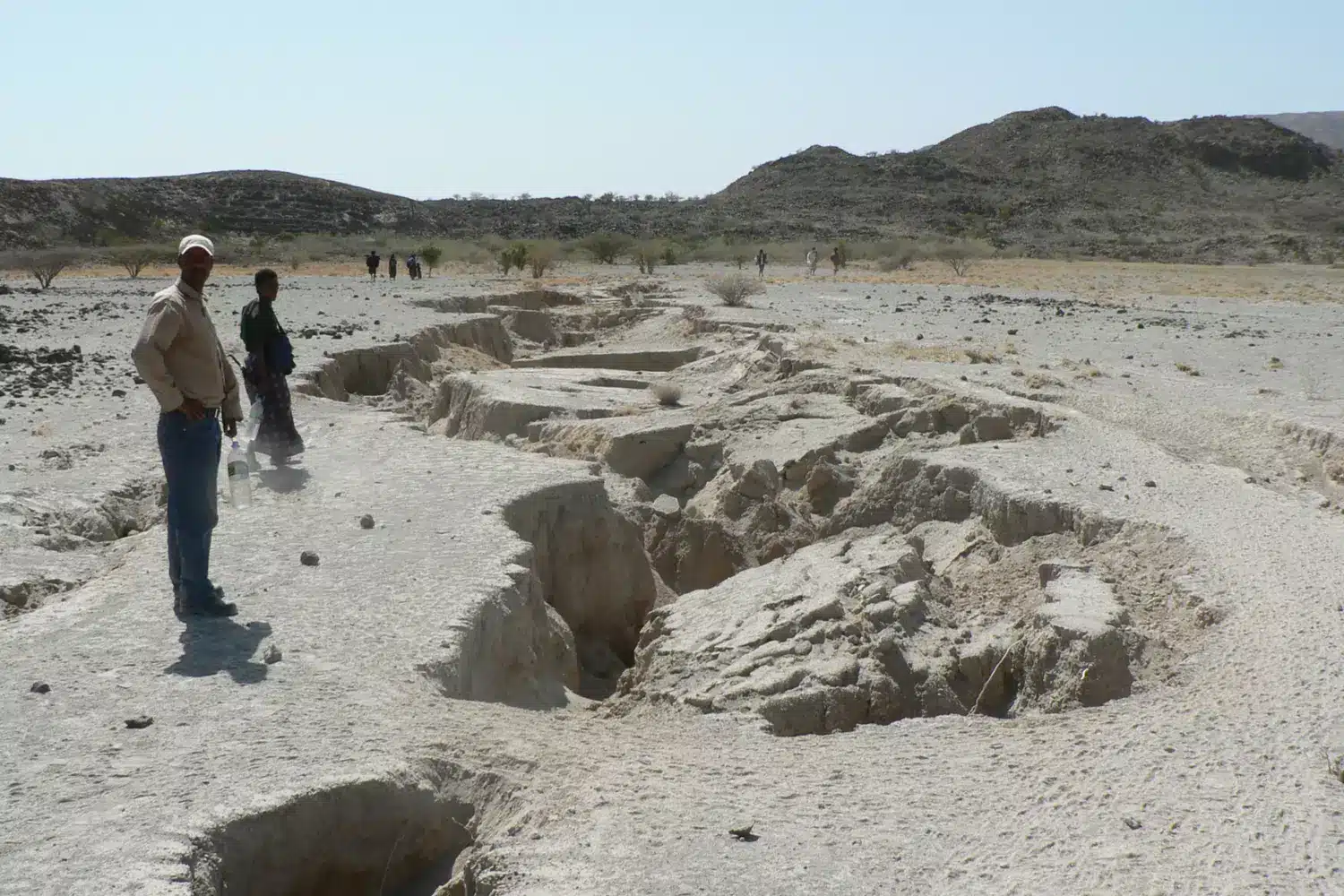
The African continent harbors one of Earth’s most spectacular geological phenomena currently unfolding. A massive rift system extends across East Africa, creating a visible fracture that scientists believe will eventually split the continent in two. This extraordinary transformation represents a rare opportunity to witness planetary evolution in action, as tectonic forces work relentlessly to reshape Africa’s geography and potentially create an entirely new ocean.
The East African Rift System stretches approximately 6,000 kilometers, running from Mozambique in the south through Tanzania, Kenya, Ethiopia, and extending toward the Red Sea. This immense geological structure marks the boundary where three major tectonic plates converge and diverge simultaneously. The Somali, African, and Arabian plates have been engaged in a slow-motion separation for roughly 25 million years, generating a dramatic landscape characterized by deep valleys and towering volcanic formations.
Understanding the tectonic mechanisms driving continental separation
The forces responsible for Africa’s continental rifting originate deep within Earth’s mantle, where intense heat generates convection currents that push against the overlying crust. These powerful movements create tension zones where the lithosphere becomes stretched and weakened over geological timeframes. As the strain accumulates, the continent literally begins to tear apart along predetermined fault lines.
Mount Kilimanjaro stands as a prominent reminder of the volcanic activity associated with this rifting process. The mountain represents just one example of the numerous volcanic features that have emerged along the rift valley. These geological formations provide scientists with valuable clues about the intensity and progression of the tectonic forces at work beneath the surface.
What makes this phenomenon particularly remarkable is the measurable rate of separation. The Horn of Africa, encompassing Somalia, Ethiopia, and portions of Kenya, moves away from the continental mainland at several millimeters to centimeters annually. While this pace might seem insignificant in human terms, it represents extraordinary velocity in geological contexts. Over millions of years, these incremental movements accumulate into thousands of kilometers of displacement.
Recent observations have revealed surprising variations in separation speed. In 2005, scientists documented a dramatic event in western Ethiopia where a 60-kilometer-long fissure opened suddenly. Within mere minutes, the ground separated by approximately two meters—a displacement that would typically require centuries to achieve through gradual tectonic movement. This unexpected acceleration has prompted researchers to reconsider their timeline estimates for complete continental separation.
The formation process of new oceanic basins
Continental rifting follows a predictable sequence that geologists have observed in various locations worldwide. The process begins with crustal thinning, followed by volcanic activity, and ultimately progresses to seafloor spreading. Gilles Chazot, a geologist specializing in tectonic processes, emphasizes that all Earth’s oceans originated through similar continental fracturing events.
The Atlantic Ocean provides a perfect historical example of this phenomenon. Millions of years ago, Africa and the Americas formed a single landmass before tectonic forces gradually pulled them apart. The resulting ocean basin now spans thousands of kilometers, completely separating continents that once shared borders. This same process appears destined to repeat itself in East Africa.
Several key stages characterize ocean formation through continental rifting :
- Initial rifting phase : The continental crust stretches and thins, creating valleys and fault systems that gradually deepen over time
- Volcanic activity intensification : Magma rises through weakened crustal zones, generating volcanic mountains and lava flows along the rift valley
- Seawater infiltration : As the rift deepens below sea level, water begins entering the depression, initially forming lakes or inland seas
- Seafloor spreading initiation : New oceanic crust forms continuously as magma rises and solidifies, pushing the continental margins progressively farther apart
The emerging African rift will likely extend from the Afar region through Kenya and potentially along Tanzania’s eastern border. This massive geological boundary will effectively transform the Horn of Africa into an enormous island, separated from mainland Africa by a newly formed ocean. The Red Sea and Gulf of Aden already demonstrate early stages of this process, having separated the Arabian Peninsula from Africa over the past 30 million years.
Regional implications and future projections
The strategic significance of this geological transformation extends beyond pure scientific interest. The Horn of Africa occupies a crucial position controlling access to the Red Sea and Suez Canal, through which substantial portions of global maritime trade flow continuously. Any significant geographical changes in this region could potentially affect international shipping routes, regional ecosystems, and local populations.
Scientists continue debating the timeline for complete continental separation. Traditional estimates suggest millions of years remain before a fully formed ocean emerges. However, the 2005 Ethiopian fissure event has introduced uncertainty into these projections. Some researchers now speculate that geological processes might accelerate under certain conditions, potentially shortening the expected timeframe significantly.
The exact trajectory and ultimate configuration of the rift remain subjects of ongoing research. Geologists employ satellite measurements, seismic monitoring, and ground-based observations to track the rift’s progression with increasing precision. These technologies provide unprecedented insights into continental dynamics and allow scientists to refine their predictive models continuously.
This extraordinary geological event offers humanity a unique window into planetary evolution. Unlike most geological processes that unfold over timeframes beyond human observation, Africa’s continental split progresses at rates that modern scientific instruments can measure and document. This real-time geological laboratory enables researchers to test theories about Earth’s dynamic crust and better understand how continents have formed, separated, and reconfigured throughout our planet’s history.
