
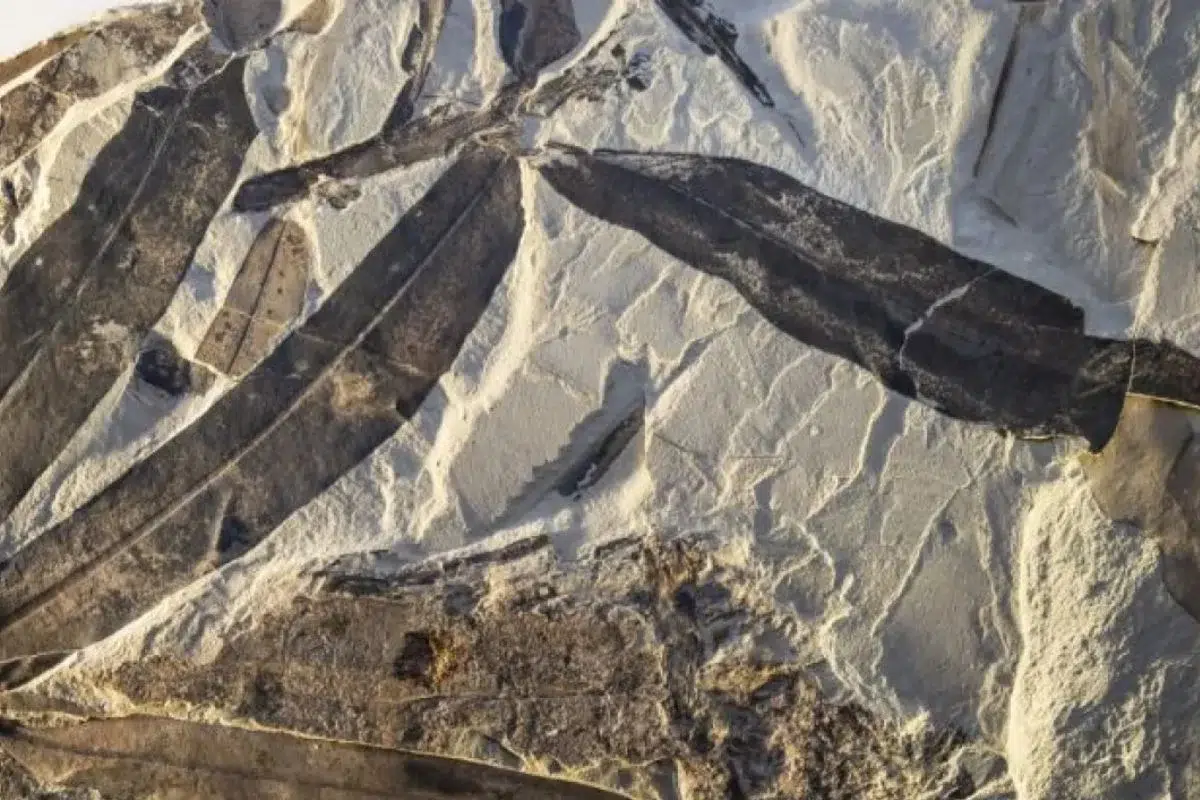
Buried within archived specimens for decades, a plant fossil from Utah’s ancient lakebeds has recently emerged from scientific obscurity to challenge everything botanists thought they understood about evolutionary lineages. The remarkable preservation of Othniophyton elongatum, dating back 47 million years, reveals a specimen so unusual that researchers cannot place it within any existing plant family, living or extinct.
When archived specimens reveal unexpected mysteries
The story begins with Steven Manchester, curator at the Florida Museum of Natural History, stumbling upon an overlooked fossil tucked away in Berkeley University’s collections. This particular specimen displayed something extraordinary : a complete branch bearing leaves, flowers, and fruits all preserved together. Manchester quickly recognized similarities to leaf impressions described in 1969, already catalogued under the name Othniophyton elongatum, which translates roughly as “strange plant”.
Previous researchers had only examined isolated leaves with their intricate vein patterns, leading to a tentative classification alongside ginseng and related Araliaceae species. However, the newly discovered material immediately contradicted this assumption. The leaves weren’t compound structures as expected, but simple formations attached directly to a woody stem. This revelation closed one botanical puzzle while simultaneously opening a far more perplexing question : if not ginseng, then what exactly was this ancient organism ?
The research team methodically examined the specimen against approximately 400 modern flowering plant families. Every comparison came up empty. They then turned their attention to extinct botanical groups documented in the fossil record. Still nothing matched. This unprecedented situation placed Othniophyton elongatum in an entirely separate category, representing a vanished botanical lineage previously unknown to science. The discovery challenges a widespread practice in paleobotany where scientists routinely classify relatively recent fossils, those younger than 65 million years, within modern families by default.
Microscopic details unveil botanical anomalies
The investigation took a transformative turn with cutting-edge technology. Advanced digital microscopy equipped with sophisticated shadow-rendering algorithms revealed microscopic features invisible to conventional examination methods. Research teams could now observe developing seeds, internal fruit structures, and delicate vein patterns with unprecedented clarity. These technological capabilities breathed new life into what had essentially become a paleobotanical cold case.
Among the revealed details, one reproductive characteristic particularly captured scientific attention. The fossil preserved stamens, the male reproductive organs, still attached despite the fruits reaching full maturity. In modern flowering plants, these structures typically fall away once pollination completes successfully. Yet here they remained, defying contemporary botanical understanding. Julian Correa-Narvaez, doctoral candidate at the University of Florida and study co-author, emphasized the significance : researchers cannot identify any living plant species exhibiting this peculiar reproductive strategy.
The berries themselves eliminated several possible classifications. Their presence ruled out relationships with grasses or magnolias immediately. While the flowers showed superficial resemblances to certain modern families, none proved substantial enough to establish credible evolutionary connections. The specimen’s unique combination of features includes :
- Simple leaves directly attached to woody stems
- Berry-type fruits with persistent stamens
- Intricate venation patterns unlike any known family
- Flower structures showing only vague similarities to modern species
Exceptional preservation in ancient volcanic lakebeds
The fossil originates from the Green River Formation near Rainbow, an abandoned settlement in eastern Utah. During the Eocene epoch, this region contained an enormous inland lake characterized by oxygen-poor waters enriched with volcanic ash. These specific environmental conditions created ideal circumstances for capturing extraordinarily detailed impressions of ancient life. The volcanic sediments essentially froze moments in time, preserving even microscopic seed structures with remarkable fidelity.
Despite this exceptional preservation quality, scientists remain unable to construct a family tree for Othniophyton elongatum. Correa-Narvaez underscores the broader implications : this fossil demonstrates how drastically different ancient plant diversity could be from contemporary ecosystems. The specimen serves as tangible evidence that evolutionary history contains numerous discontinued chapters, lineages that flourished then vanished without leaving modern descendants.
The Green River Formation has yielded surprises before. Fossils described during the 1960s remained incompletely understood for decades. Modern analytical tools now enable researchers to reexamine these historical treasures with fresh perspectives. Digital platforms like iDigBio have revolutionized paleobotanical research by providing remote access to entire collections worldwide, eliminating the need for physical specimen handling.
Digital revolution transforms botanical detective work
This discovery highlights how technological advancement reshapes scientific understanding. The combination of archived specimens and contemporary imaging technology creates opportunities impossible just years ago. Researchers can now extract information from fossils that previous generations of scientists simply couldn’t access, regardless of their expertise or dedication.
The implications extend beyond single specimens. The discovery challenges paleobotanists to reconsider their classification assumptions, particularly for relatively recent fossil material. Automatically assigning ancient plants to modern families, while methodologically convenient, potentially obscures the true diversity of prehistoric ecosystems. Othniophyton elongatum stands as compelling evidence that extinct botanical groups may be far more numerous than currently recognized.
This botanical orphan reminds us that evolution’s experimentation produced countless variations, many of which left no living representatives. Sometimes a single fossilized branch, preserved through fortunate geological circumstances and rediscovered through persistent curiosity, can reopen entire forgotten chapters of life’s history. The plant represents a unique evolutionary experiment that thrived millions of years ago before disappearing completely, leaving only faint impressions in ancient lakebed sediments as testament to its existence.
